


Trust Structure & Governance
St Benet’s MAT is a Multi Academy Trust and therefore the responsibility for governance rests with the Members and the Trust Board. The Members are responsible for appointing Trustees and they hold the Trust Board to account for the effective governance of the Trust. The Trustees have a broad range of skills and experience from both the education and business worlds.
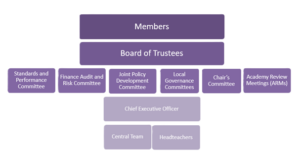
The board has two sub-committees whose role is to scrutinise the work of the Trust and hold St Benet’s MAT officers to account in accordance with the Articles of Association and Scheme of Delegation:
- Finance, Audit and Risk Committee
- Standards and Performance Committee
All sub-committees report back to Trustees at each Board Meeting.
In addition, two St Benet’s Trustees represent the Trust on the Joint Policy Development Committee which develops and reviews policies for St Benet’s MAT, DNEAT (Diocese of Norwich Education and Academies Trust) and DoNESC (Diocese of Norwich Education Services Company).
The CEO and Improvement Directors (IDs) provide support and challenge to the headteachers in the academies. This is carried out via a regular schedule of visits to the academies. Collaborative working across the MAT is facilitated through the Trust Training programme.
The principal responsibility of the Academy Review Meeting (ARM) is to hold leaders, including governors, to account for academy improvement. For our academies there are three scheduled meetings each year, these are to be held during the early part of each term.
At each ARM, the academy’s senior leaders will report progress against identified priorities within the approved Academy Improvement and Development Plan. Their view of progress will be validated by the Trust Officer chairing the meeting and reports from other professionals working with each academy. The ARM is a mechanism for ensuring that rapid improvements are made. Its purpose is:
- To hold the Headteacher to account for academy improvement.
- To hold the LGC to account for those responsibilities delegated to it.
Local governance at academy level is conducted via a Local Governance Committee (LGC) which comprises Trust Appointed Governors, Parent Governors, a Staff Governor and the Headteacher. Responsibilities from the Trust Board are delegated via a Scheme of Delegation which is reviewed on an annual basis. The LGC is expected to meet in full on a termly basis and carry out monitoring activities throughout the year. The Chairs of Governors meet on a regular basis with the Trust via the Academy Review Meetings and an annual Chair’s Committee.
The Trust provides guidance and support to the LGCs through the provision of draft agendas, supporting documents, quality assurance visits and in-house training for governors.
Board and Local Governance Committee Diversity
Our trustees and governors are volunteers and providing diversity information is also voluntary at the point of application. In August 2026 our governing community (Trust Board and Local Governance Committees) had provided the following information.
Age
31 – 45 : 47 %
46 – 60 : 24%
61 and over : 12%
Gender
Female : 52%
Male : 46%
Religion or Belief
Christian : 71%
No religion or belief : 22%
We also collect data on ethnicity, disability and sexual orientation but have chosen not to publish data in these areas at present.

The Trust’s Accounting Officer is Sam Nixon (CEO).
Declared interest: Sam Nixon is a former Director for the Diocese of Norwich Education Services Company (DoNESC) 13 January 2025-28 May 2026.